

AI Speech Analytics for Contact Centers: The Complete Guide to Smarter Customer Conversations
Every customer conversation contains valuable information about your business. Hidden within support calls are product complaints, buying signals, service issues, compliance risks, and opportunities to improve customer experience. The challenge is that most organizations review only a small fraction of these interactions, leaving valuable insights undiscovered.
AI Speech Analytics changes this by automatically analyzing customer conversations at scale. Using technologies such as Automatic Speech Recognition (ASR), Natural Language Processing (NLP), Machine Learning (ML), and Large Language Models (LLMs), it converts voice conversations into actionable business intelligence. Instead of relying on random quality checks or manual reviews, organizations can understand every interaction, identify customer sentiment, detect intent, monitor compliance, and uncover trends that drive better business decisions.
Whether you're managing a contact center with hundreds of agents or a growing customer support team, AI speech analytics helps improve service quality, reduce operational costs, increase agent productivity, and deliver more personalized customer experiences.
In this comprehensive guide, you'll learn:
- What AI Speech Analytics is and how it works
- The technologies powering modern speech analytics platforms
- Key features and business benefits
- Industry use cases and real-world applications
- Best practices for implementation
- Future trends shaping AI-powered contact centers
- How Kaira Software can help organizations unlock the value of conversational intelligence
If your organization wants to transform customer conversations into measurable business outcomes, this guide will provide everything you need to understand AI speech analytics and its growing role in modern customer service.
Why Every Customer Conversation Matters
Imagine your contact center receives 10,000 customer calls every month.
Some customers are reporting technical issues. Others are asking about pricing, requesting refunds, renewing subscriptions, or sharing feedback about your products and services. Each conversation contains information that can help improve your business.
Now consider how many of those conversations your managers actually review.
For most organizations, the answer is surprisingly small. Traditional quality assurance teams typically evaluate only a sample of calls because manually listening to thousands of recordings takes significant time and effort. As a result, recurring customer issues, emerging market trends, and coaching opportunities often go unnoticed.
This creates a gap between what customers are experiencing and what businesses believe is happening.
AI Speech Analytics bridges that gap by automatically analyzing every conversation—not just a small sample. Instead of spending hours listening to recordings, managers receive meaningful insights into customer behavior, agent performance, service quality, and operational efficiency.
For example, a retail business might discover that customers frequently mention delivery delays during support calls. A telecom provider may notice an increase in complaints about network performance in a specific region. An insurance company could identify recurring confusion around claims processing. These patterns may remain hidden when only a handful of conversations are reviewed manually.
By analyzing customer interactions at scale, organizations gain a much clearer understanding of what customers need, where service processes can improve, and how business decisions can be backed by real customer data rather than assumptions.
Today's contact centers are no longer viewed simply as customer support functions. They have become valuable sources of business intelligence, providing insights that influence sales strategies, product development, marketing campaigns, compliance initiatives, and customer experience programs.
Key Takeaway
Every customer conversation is a source of business intelligence. AI Speech Analytics enables organizations to capture insights from every interaction instead of relying on limited manual reviews.
Why Businesses Are Investing in AI Speech Analytics
Organizations are investing in AI Speech Analytics because customer expectations have changed. Businesses are expected to provide faster responses, personalized experiences, consistent service, and regulatory compliance—all while controlling operational costs. Speech analytics helps achieve these goals by turning customer conversations into actionable insights.
Customer service has become one of the biggest differentiators in today's competitive market. Customers expect quick resolutions, knowledgeable agents, and personalized interactions regardless of the communication channel they choose.
At the same time, businesses face increasing pressure to:
- Improve customer satisfaction
- Reduce average handling time
- Maintain regulatory compliance
- Increase first-call resolution
- Identify sales opportunities
- Lower operational costs
- Coach agents more effectively
Meeting all these objectives through manual call monitoring alone is almost impossible.
Consider a financial services organization handling thousands of customer calls every day. Supervisors may only have enough time to review a few conversations per agent each month. While these reviews provide useful feedback, they represent only a small fraction of actual customer interactions.
This limited visibility can result in:
- Missed compliance violations
- Undetected customer frustration
- Lost sales opportunities
- Inconsistent agent performance
- Delayed coaching
- Repeated customer issues
AI Speech Analytics addresses these challenges by continuously monitoring conversations, identifying patterns, and providing managers with actionable recommendations.
Instead of asking, "Which calls should we review?", organizations can focus on "What insights can we gain from every customer interaction?"
The shift is significant. Contact centers are moving away from reactive quality monitoring toward proactive decision-making powered by data.
For example:
- A healthcare provider can identify recurring appointment scheduling issues before patient satisfaction declines.
- An e-commerce company can detect increasing complaints about delayed deliveries and address logistics challenges early.
- A telecommunications provider can recognize emerging service disruptions in specific regions based on customer conversations.
- A bank can automatically identify conversations requiring compliance reviews without manually listening to thousands of calls.
These insights help organizations solve problems sooner, improve customer experiences, and make more informed business decisions.
Business Challenges AI Speech Analytics Solves
Modern speech analytics platforms help organizations address several common operational challenges:
Limited Visibility into Customer Conversations
Most businesses review only a small percentage of customer interactions. AI enables organizations to analyze every conversation, ensuring valuable insights are not missed.
Inconsistent Quality Monitoring
Manual evaluations often vary between reviewers. AI applies consistent evaluation criteria across all conversations, improving fairness and standardization.
Rising Customer Expectations
Customers expect faster resolutions and personalized experiences. By identifying customer intent and sentiment in real time, organizations can deliver more relevant support.
Compliance Risks
Industries such as banking, insurance, and healthcare must follow strict regulatory requirements. Speech analytics automatically detects missing disclosures, prohibited language, or deviations from approved scripts, helping reduce compliance risks.
Agent Coaching
Instead of relying on occasional performance reviews, managers receive continuous insights into coaching opportunities, allowing them to support agents more effectively.
Business Intelligence
Customer conversations reveal recurring issues, feature requests, competitor mentions, and emerging trends. These insights can guide product development, marketing strategies, and operational improvements.
Key Takeaway
Organizations are not adopting AI Speech Analytics simply to automate call reviews. They are investing in a smarter way to understand customers, improve operations, strengthen compliance, and make better business decisions using real conversation data.
What Is AI Speech Analytics?
AI Speech Analytics is a technology that automatically analyzes spoken conversations between customers and agents to uncover insights that improve customer experience, operational efficiency, and business performance. Instead of simply recording calls, it helps organizations understand what was said, why it was said, how customers felt, and what actions should be taken next.
Think about a customer calling their internet service provider because of repeated connectivity issues.
During the conversation, the customer explains the problem, expresses frustration about previous unresolved complaints, and finally agrees to continue using the service after the agent offers a solution.
To a human reviewer, this is one call among thousands.
To an AI Speech Analytics platform, it is a rich source of information.
The platform can automatically identify:
- The reason for the call
- The customer's emotional journey throughout the conversation
- Whether mandatory compliance statements were delivered
- If the issue was resolved during the first interaction
- Opportunities for cross-selling or retention
- Coaching opportunities for the agent
- Emerging trends when similar issues appear across many calls
This allows organizations to move beyond simply storing call recordings and begin extracting meaningful business intelligence from every customer interaction.
At its core, AI Speech Analytics combines several advanced technologies:
- Automatic Speech Recognition (ASR) converts spoken language into searchable text.
- Natural Language Processing (NLP) interprets the meaning and context of conversations.
- Machine Learning (ML) identifies patterns across thousands of interactions.
- Large Language Models (LLMs) generate summaries, recommendations, and conversational insights.
- Sentiment Analysis evaluates customer emotions throughout the interaction.
Together, these technologies transform raw voice conversations into structured insights that support better customer service, stronger compliance, improved agent performance, and more informed business decisions.
AI Speech Analytics vs. Voice Analytics
Although the terms are often used interchangeably, they focus on different aspects of customer conversations.
AI Speech Analytics primarily examines the words and context of a conversation. It identifies customer intent, detects recurring topics, generates summaries, and uncovers business insights from what customers and agents actually say.
Voice Analytics, on the other hand, looks beyond spoken words. It analyzes vocal characteristics such as tone, pitch, pace, pauses, stress, and emotion to better understand how something is being said.
In practice, many modern enterprise platforms combine both capabilities to provide a more complete understanding of customer interactions.
AI Speech Analytics vs. Conversational Intelligence
Conversational Intelligence is a broader discipline that combines speech analytics, voice analytics, customer behavior analysis, CRM data, and business context to improve decision-making across customer-facing teams.
AI Speech Analytics forms the foundation by extracting insights from conversations, while Conversational Intelligence connects those insights with broader business systems to improve sales, customer support, product development, and strategic planning.
As organizations continue their digital transformation journey, speech analytics is becoming an essential building block for delivering intelligent, data-driven customer experiences.
How AI Speech Analytics Works
Every customer conversation follows a journey - from spoken words to business insights. AI Speech Analytics captures voice interactions, converts them into text, understands the context, identifies patterns, measures customer sentiment, and finally presents actionable recommendations through easy-to-understand dashboards. The entire process happens automatically, enabling organizations to analyze thousands of conversations with speed and consistency.
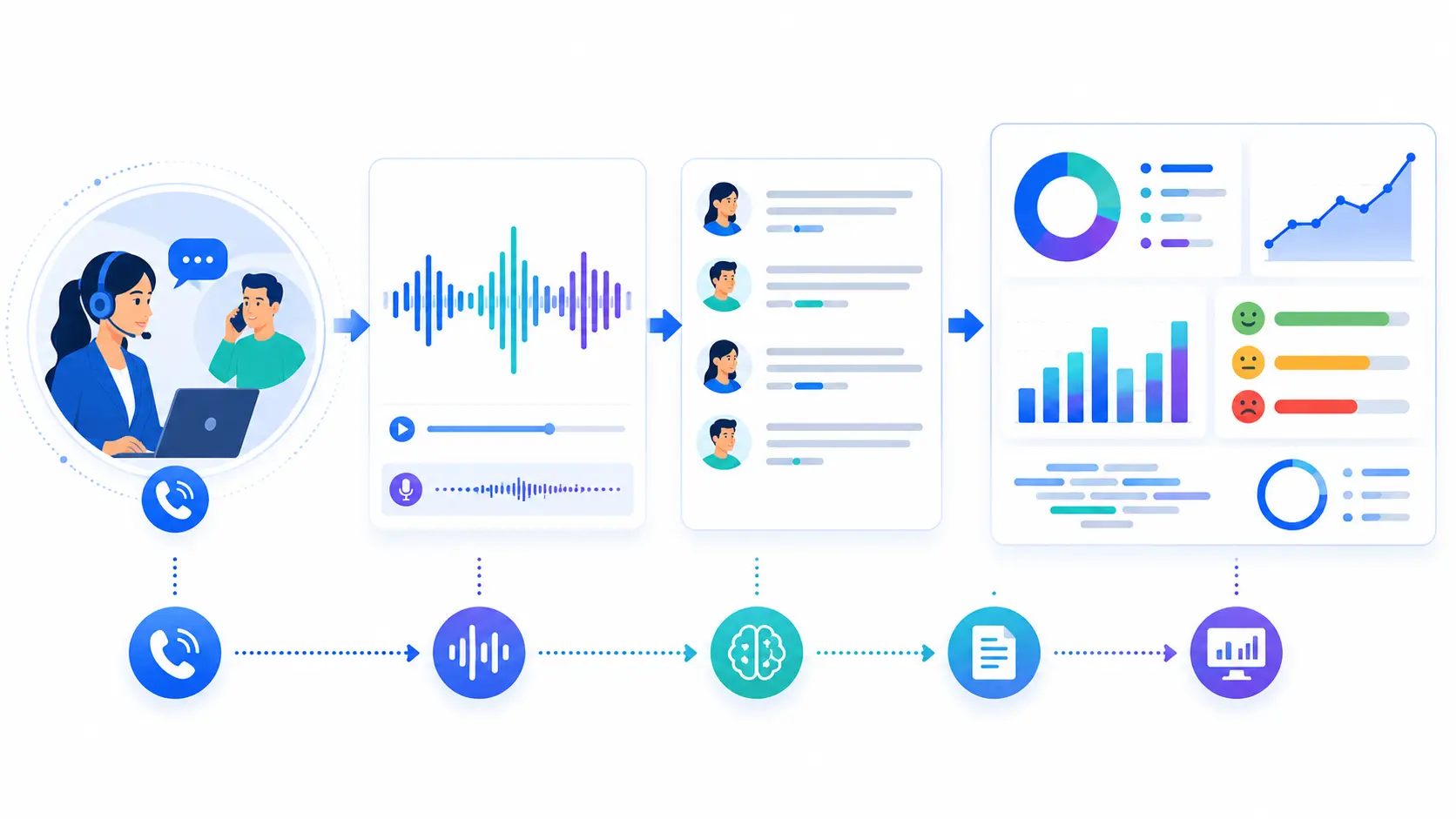
How AI Speech Analytics transforms customer conversations into actionable business insights-from voice capture and transcription to AI-powered analytics and decision-making.
Imagine a customer calls their insurance company to check the status of a claim.
The customer explains the situation, asks several questions, expresses frustration about delays, and eventually receives an update from the support representative.
To a human supervisor, reviewing this single conversation might take 10–15 minutes.
Now imagine reviewing 50,000 similar calls every month.
That's where AI Speech Analytics makes a difference.
Instead of listening to every recording manually, the platform processes conversations automatically, identifying customer intent, measuring emotions, detecting compliance issues, highlighting recurring topics, and generating meaningful business insights within minutes.
Although the technology behind speech analytics is sophisticated, the overall process can be understood through a series of simple steps.
Step 1: Capture Customer Conversations
Everything begins with customer interactions.
Modern contact centers receive conversations through multiple communication channels, including:
- Voice calls
- VoIP systems
- Contact center platforms
- Video support sessions
- Voice assistants
- Interactive Voice Response (IVR) systems
Every conversation becomes a valuable source of customer data.
Unlike traditional quality monitoring, which evaluates only selected recordings, AI platforms can process every interaction, giving organizations a much broader understanding of customer experiences.
Real-World Example
A telecom company handling 25,000 support calls each month can analyze every conversation instead of randomly reviewing only a few hundred. This significantly improves visibility into customer concerns and service quality.
Step 2: Convert Speech into Text
Once the conversation is captured, the platform converts spoken language into searchable text using Automatic Speech Recognition (ASR).
This is much more than basic transcription.
Modern ASR engines can:
- Recognize multiple speakers
- Handle different accents and dialects
- Process industry-specific terminology
- Detect timestamps
- Separate customer and agent conversations
The resulting transcript becomes the foundation for every analysis that follows.
For example, instead of storing an audio recording that requires manual playback, the organization now has structured text that can be searched, categorized, and analyzed instantly.
Step 3: Identify Who Is Speaking
Understanding a conversation requires knowing who said what.
Speech analytics platforms use Speaker Diarization to distinguish between different participants in a conversation.
This separation allows the system to measure important metrics such as:
- Customer talk time
- Agent talk time
- Interruptions
- Silence periods
- Talk-to-listen ratio
- Response times
These insights help managers evaluate communication quality rather than simply measuring call duration.
For example, if agents consistently dominate conversations without giving customers enough time to explain their concerns, coaching opportunities become immediately visible.
Step 4: Understand the Meaning Behind the Conversation
After the transcript is created, the platform applies Natural Language Processing (NLP) to understand what the conversation is actually about.
Rather than simply recognizing words, NLP analyzes:
- Customer intent
- Conversation context
- Frequently discussed topics
- Product mentions
- Service requests
- Complaint categories
- Frequently asked questions
This allows businesses to move beyond transcripts and begin understanding customer needs at scale.
For example, if thousands of customers mention delayed deliveries during a particular week, the platform groups those conversations together, making it easier for operations teams to identify supply chain issues before they become widespread problems.
Step 5: Measure Customer Sentiment
Words alone don't always reveal how customers feel.
A customer might politely say,
"That's fine."
while actually sounding frustrated.
Speech analytics combines language understanding with vocal characteristics to determine customer sentiment throughout a conversation.
Instead of assigning a single emotional score to an entire call, modern platforms often track how emotions change over time.
For example:
- The customer begins the call frustrated.
- The support agent provides clear guidance.
- The issue is resolved.
- The customer ends the conversation satisfied.
This emotional journey gives managers a much more accurate picture of service quality than a simple "positive" or "negative" rating.
Organizations can use these insights to:
- Improve customer satisfaction
- Identify recurring pain points
- Evaluate agent empathy
- Reduce escalations
- Strengthen coaching programs
Key Takeaway
Sentiment analysis isn't about labeling conversations as good or bad. It's about understanding how customer emotions change throughout an interaction and identifying what influenced those changes.
Step 6: Detect Business Events Automatically
One of the biggest advantages of AI Speech Analytics is its ability to identify events that matter to the business.
Instead of searching conversations manually, organizations can automatically detect situations such as:
- Cancellation requests
- Refund discussions
- Billing disputes
- Compliance violations
- Competitor mentions
- Escalation requests
- Upselling opportunities
- Customer complaints
- Product feedback
- Service outages
These events can trigger workflows, notifications, or reports without requiring human intervention.
For instance, if a customer repeatedly mentions switching to a competitor, the system can flag the conversation for the retention team before the account is lost.
Similarly, if mandatory regulatory disclosures are missing during financial service calls, compliance teams can receive immediate alerts for review.
Step 7: Generate Actionable Insights
Collecting data is only valuable if it leads to better decisions.
Once conversations have been analyzed, the platform transforms raw information into business intelligence through interactive dashboards and reports.
Instead of reviewing thousands of individual calls, managers receive visual summaries showing:
- Customer sentiment trends
- Most common reasons for contact
- First Call Resolution (FCR)
- Average Handle Time (AHT)
- Agent performance
- Compliance scores
- Escalation rates
- Frequently discussed products
- Emerging customer issues
- Coaching opportunities
These dashboards help different teams answer different business questions.
A customer support manager may focus on improving service quality.
A sales manager may look for buying signals.
A compliance officer may review policy violations.
An executive may monitor customer satisfaction trends across regions.
The same conversation data supports multiple business functions, making AI Speech Analytics valuable well beyond the contact center.
Bringing It All Together
Although AI Speech Analytics involves several advanced technologies, the process follows a logical flow:
- Customer conversations are captured.
- Speech is converted into text.
- Speakers are identified.
- Language and context are analyzed.
- Customer sentiment is measured.
- Business events and patterns are detected.
- Dashboards provide actionable insights for decision-makers.
The result is a complete view of customer interactions without the time-consuming effort of manual call reviews.
Key Takeaway
AI Speech Analytics doesn't simply record conversations - it transforms them into business intelligence. By analyzing every customer interaction automatically, organizations can improve service quality, strengthen compliance, coach agents more effectively, and make faster, data-driven decisions.
Technologies Behind AI Speech Analytics
Behind every AI Speech Analytics platform is a combination of intelligent technologies working together. Speech recognition converts audio into text, Natural Language Processing understands meaning, Machine Learning identifies patterns, and Generative AI turns insights into summaries and recommendations. Individually these technologies are powerful; together they enable organizations to understand customer conversations at scale.
Many business leaders think of AI Speech Analytics as a single technology.
In reality, it's an ecosystem of specialized AI capabilities, each responsible for solving a different part of the problem.
Understanding these building blocks makes it easier to evaluate different speech analytics platforms and appreciate how they generate accurate, actionable insights.
Let's explore the core technologies that power modern speech analytics solutions.
1. Automatic Speech Recognition (ASR)
Every analysis begins with converting spoken language into text.
Automatic Speech Recognition (ASR) listens to customer conversations and produces accurate transcripts that computers can analyze.
Modern ASR systems can:
- Recognize multiple speakers
- Handle different accents and dialects
- Understand industry terminology
- Process conversations in near real time
- Generate searchable transcripts
High transcription accuracy is essential because every subsequent analysis depends on the quality of this first step.
2. Natural Language Processing (NLP)
Once a transcript is available, the system needs to understand what was actually discussed.
Natural Language Processing interprets human language by analyzing context, grammar, intent, and meaning.
Rather than focusing on individual keywords, NLP helps answer questions such as:
- Why did the customer call?
- Was the issue resolved?
- Which product or service was discussed?
- Was the customer asking for information, making a complaint, or considering a purchase?
This contextual understanding is what makes modern speech analytics far more valuable than traditional keyword searches.
3. Machine Learning (ML)
Machine Learning allows the platform to improve continuously by recognizing patterns across thousands-or even millions-of conversations.
Instead of relying solely on predefined rules, ML identifies recurring behaviors, predicts trends, and adapts as new data becomes available.
For example, it can learn to recognize:
- Calls likely to escalate
- Common reasons for repeat contacts
- Indicators of customer churn
- Coaching opportunities for agents
The more relevant data the system processes, the better it becomes at surfacing meaningful insights.
4. Large Language Models (LLMs)
Large Language Models bring a new level of intelligence to speech analytics.
Rather than simply classifying conversations, LLMs can understand nuance, summarize discussions, extract action items, and generate natural-language recommendations.
For contact centers, this means tasks that once took agents several minutes-such as writing call summaries or updating CRM notes-can now be completed automatically.
This reduces after-call work while ensuring documentation remains consistent and accurate.
5. Sentiment Analysis
Customer satisfaction is influenced not only by what is said but also by how interactions unfold.
Sentiment analysis evaluates language patterns and, where supported, vocal characteristics to estimate customer emotions throughout a conversation.
Instead of treating a call as entirely positive or negative, modern systems can identify emotional shifts from frustration to satisfaction or from curiosity to purchase intent.
These insights help managers evaluate service quality more effectively and identify opportunities for coaching or process improvements.
6. Speaker Diarization and Acoustic Intelligence
Understanding conversations requires separating participants and analyzing how they communicate.
Speaker diarization identifies who is speaking, while acoustic intelligence evaluates characteristics such as pauses, interruptions, speaking pace, and silence.
Together, these technologies provide a more complete view of conversation quality beyond the spoken words alone.
7. Predictive Analytics
The latest generation of speech analytics platforms goes beyond reporting past events.
Predictive analytics uses historical conversation data to forecast likely outcomes, such as customer churn, repeat contacts, or increased demand for specific products or services.
By anticipating what may happen next, organizations can respond proactively instead of reacting after problems occur.
Key Takeaway
AI Speech Analytics is powered by multiple complementary technologies, each contributing a specific capability. Together, they transform unstructured customer conversations into meaningful insights that improve customer experience, operational efficiency, and strategic decision-making.
Key Features of AI Speech Analytics
Modern AI Speech Analytics platforms do much more than transcribe customer calls. They help organizations understand customer behavior, monitor compliance, coach agents, automate repetitive tasks, and uncover business opportunities hidden within everyday conversations. Together, these capabilities transform customer interactions into a valuable source of operational and strategic insights.
Think about the difference between owning thousands of customer call recordings and actually learning something from them.
Most organizations already record calls.
The challenge isn't collecting data-it's extracting meaningful insights from it.
This is where modern speech analytics platforms stand apart. Instead of storing conversations as audio files, they automatically organize, analyze, and interpret every interaction.
Let's explore the capabilities that make this possible.
Automatic Call Transcription
Every conversation begins as an audio recording.
The first step is converting that recording into searchable, structured text using Automatic Speech Recognition (ASR).
Unlike manual transcription, this happens automatically within seconds.
Once conversations are available as text, organizations can:
- Search for specific topics
- Review customer interactions quickly
- Share conversations internally
- Analyze trends across thousands of calls
For example, instead of listening to hundreds of recordings to investigate billing complaints, managers can instantly search for conversations containing terms like invoice, payment, or refund.
AI-Generated Call Summaries
One of the biggest productivity improvements comes after the conversation ends.
Traditionally, agents spend valuable time writing notes, updating CRM systems, and documenting customer interactions.
Modern AI platforms automatically generate concise summaries that capture:
- Customer concerns
- Resolution provided
- Follow-up actions
- Commitments made
- Recommended next steps
This significantly reduces after-call work, allowing agents to spend more time helping customers rather than completing administrative tasks.
Real-World Example
A support team handling hundreds of daily calls can save several minutes after each interaction by automating call summaries. Over weeks and months, these small time savings translate into substantial productivity gains.
Customer Sentiment Analysis
Customer satisfaction isn't determined solely by whether an issue was resolved.
How customers feel during the interaction is equally important.
Sentiment analysis helps organizations understand emotional changes throughout a conversation.
Rather than simply classifying calls as "positive" or "negative," modern platforms identify emotional shifts, such as:
- Frustration
- Satisfaction
- Confusion
- Appreciation
- Urgency
- Confidence
These insights allow managers to identify conversations requiring coaching, recognize outstanding agent performance, and better understand customer expectations.
Customer Intent Detection
Customers rarely begin a conversation by stating exactly what category it belongs to.
Instead, they explain a situation.
Intent detection identifies the underlying purpose of every interaction, such as:
- Technical support
- Billing enquiry
- Product information
- Account cancellation
- Upgrade request
- Complaint
- Order tracking
Grouping conversations by intent helps organizations understand why customers contact them and where improvements can be made.
For example, if thousands of customers are calling about password resets, it may indicate the need for a simpler self-service authentication process.
Topic Discovery and Trend Analysis
One isolated complaint may not require immediate attention.
Hundreds of similar complaints usually indicate a larger business issue.
Speech analytics continuously groups related conversations together, helping organizations identify emerging trends before they become widespread problems.
These trends might include:
- Product defects
- Website issues
- Delivery delays
- Service outages
- Pricing confusion
- Frequently requested features
Rather than waiting for monthly reports, businesses can identify problems as they begin to emerge.
Compliance Monitoring
For industries such as banking, insurance, healthcare, and telecommunications, compliance is a critical business requirement.
AI Speech Analytics continuously monitors conversations to ensure agents follow approved processes.
The system can automatically detect:
- Missing disclosures
- Mandatory statements
- Sensitive language
- Regulatory violations
- Script deviations
Instead of manually auditing thousands of calls, compliance teams can focus their attention only on conversations requiring review.
Agent Performance Analytics
Traditional performance reviews often rely on limited observations.
Speech analytics provides managers with a much broader perspective.
Rather than reviewing a few calls every month, supervisors can evaluate performance across every customer interaction.
This helps identify:
- Coaching opportunities
- Knowledge gaps
- High-performing agents
- Communication improvements
- Consistency across teams
Managers can provide more objective coaching because recommendations are based on real conversation data rather than isolated examples.
Real-Time Agent Assistance
Modern platforms don't just analyze completed conversations.
Increasingly, they support agents while conversations are still taking place.
Depending on the solution, real-time assistance may include:
- Suggested responses
- Relevant knowledge base articles
- Compliance reminders
- Product recommendations
- Next-best actions
This enables agents to respond more confidently, particularly when handling complex or unfamiliar customer enquiries.
Interactive Dashboards and Reporting
Insights become valuable only when decision-makers can understand them easily.
Speech analytics platforms present conversation data through intuitive dashboards that help different teams answer different business questions.
Managers can monitor:
- Customer satisfaction trends
- Average Handle Time
- First Call Resolution
- Escalation rates
- Compliance performance
- Agent productivity
- Customer sentiment trends
Instead of reviewing individual conversations, leaders gain a complete view of operational performance through visual reports.
Key Takeaway
AI Speech Analytics isn't defined by one feature. Its real value comes from combining transcription, language understanding, sentiment analysis, automation, and reporting into a single platform that continuously improves customer service and business decision-making.
Business Benefits of AI Speech Analytics
Every organization expects technology investments to deliver measurable business outcomes. AI Speech Analytics creates value across customer service, operations, compliance, workforce management, and strategic planning by helping businesses make faster, smarter, and more informed decisions.
Implementing AI Speech Analytics is about much more than introducing new technology.
It represents a shift from reacting to customer issues after they occur to proactively identifying patterns, solving problems earlier, and continuously improving service delivery.
Let's explore the business impact.
Deliver Better Customer Experiences
Exceptional customer experiences begin with understanding customer needs.
By analyzing every interaction, organizations gain a clearer picture of recurring frustrations, common questions, and service expectations.
Instead of relying solely on customer surveys, businesses can learn directly from real conversations.
These insights help organizations:
- Resolve issues faster
- Personalize customer interactions
- Reduce repeat contacts
- Improve satisfaction scores
- Strengthen customer loyalty
Improve Agent Productivity
Customer support representatives often spend a significant portion of their day on administrative tasks.
Automating activities such as call summaries, CRM updates, and documentation allows agents to focus more on customers and less on paperwork.
Managers also benefit from automated performance insights, reducing the time required for manual evaluations and coaching preparation.
Accelerate Quality Assurance
Traditional quality monitoring typically reviews only a small sample of customer conversations.
Speech analytics expands visibility across every interaction.
Instead of asking:
"Which calls should we review?"
Managers can ask:
"Which conversations require our attention today?"
This dramatically improves both efficiency and consistency.
Strengthen Regulatory Compliance
Maintaining compliance becomes increasingly challenging as organizations grow.
Speech analytics continuously monitors conversations for mandatory disclosures, prohibited language, and policy adherence.
Rather than discovering compliance issues during periodic audits, organizations receive earlier visibility into potential risks, reducing exposure and improving governance.
Turn Conversations into Business Intelligence
Customer conversations often reveal valuable insights that extend far beyond the contact center.
Businesses can identify:
- Frequently requested product features
- Competitor mentions
- Pricing concerns
- Emerging market trends
- Service improvement opportunities
- Customer expectations
These insights help product teams, marketing departments, sales organizations, and executives make better-informed decisions.
Reduce Operational Costs
Many operational expenses stem from inefficient processes rather than staffing alone.
Speech analytics helps reduce costs by:
- Automating repetitive tasks
- Reducing after-call work
- Improving First Call Resolution
- Shortening training cycles
- Preventing repeat contacts
- Identifying workflow bottlenecks
Over time, these improvements contribute to measurable operational efficiencies.
Build a Culture of Continuous Improvement
Perhaps the greatest long-term benefit is creating an organization that learns from every customer interaction.
Rather than making decisions based on assumptions or isolated feedback, leaders gain continuous visibility into customer needs and operational performance.
This supports ongoing improvements across products, services, employee training, and customer experience initiatives.
Key Takeaway
AI Speech Analytics delivers value far beyond the contact center. It helps organizations improve customer satisfaction, increase efficiency, strengthen compliance, and make more informed business decisions using real customer conversations.
Business Metrics AI Speech Analytics Can Measure
One of the greatest strengths of AI Speech Analytics is its ability to convert conversations into measurable performance indicators. Instead of relying on assumptions, organizations gain objective metrics that help improve customer service, agent performance, operational efficiency, and overall business outcomes.
Customer conversations generate far more than transcripts.
Every interaction contains measurable signals that reveal how well an organization is serving its customers.
Here are some of the most valuable metrics modern speech analytics platforms can track.
Average Handle Time (AHT)
Measures the total time agents spend resolving customer interactions.
Reducing unnecessary handling time improves operational efficiency without compromising service quality.
First Call Resolution (FCR)
Tracks how often customer issues are successfully resolved during the initial interaction.
Higher FCR rates generally indicate better customer experiences and lower operational costs.
Customer Sentiment Score
Measures emotional trends across conversations to help organizations understand overall customer satisfaction and identify recurring pain points.
Customer Satisfaction Trends
Rather than relying solely on post-call surveys, organizations can monitor satisfaction patterns across thousands of conversations over time.
Talk-to-Listen Ratio
Evaluates the balance between customer and agent participation.
Agents who actively listen often achieve better outcomes than those who dominate conversations.
Silence and Hold Time
Identifies excessive pauses or long hold periods that may negatively affect customer experience.
Escalation Rate
Measures how frequently customer interactions require supervisor involvement or advanced support.
A rising escalation rate may indicate knowledge gaps, product issues, or process inefficiencies.
Compliance Score
Evaluates whether agents consistently follow required scripts, disclosures, and regulatory requirements.
Agent Empathy Score
Assesses communication patterns that demonstrate understanding, reassurance, and professionalism during customer interactions.
Customer Effort Score (CES)
Estimates how easy it was for customers to resolve their issues.
Reducing customer effort is strongly associated with improved loyalty and satisfaction.
Key Takeaway
Metrics only become valuable when they drive action. AI Speech Analytics transforms operational KPIs into actionable insights that help organizations improve both customer experience and business performance.
Industry Use Cases of AI Speech Analytics
Although AI Speech Analytics is most commonly associated with contact centers, its value extends across many industries. Any organization that interacts with customers through voice conversations can use speech analytics to improve customer experience, strengthen compliance, optimize operations, and make more informed business decisions.
No two industries have exactly the same customer conversations.
A healthcare provider focuses on patient care, while an insurance company deals with claims and policy enquiries. Banks must meet strict regulatory requirements, whereas retailers prioritize customer satisfaction and repeat purchases.
Despite these differences, they all share one common challenge:
Thousands of conversations contain valuable insights, but manually reviewing them is impractical.
AI Speech Analytics helps organizations uncover those insights automatically.
Let's look at how different industries are using the technology.
Banking and Financial Services
Banks manage thousands of customer conversations related to account enquiries, loan applications, credit cards, fraud alerts, and investment services.
These conversations are often governed by strict regulatory requirements, making consistency and compliance essential.
AI Speech Analytics helps financial institutions:
- Monitor compliance with mandatory disclosures
- Detect potential fraud indicators
- Identify customer dissatisfaction before accounts are closed
- Improve agent coaching
- Reduce complaint resolution times
- Monitor sales conversations for quality and compliance
Example
If customers frequently ask similar questions about mortgage eligibility or digital banking services, banks can improve their self-service resources while reducing call volumes.
Insurance
Insurance providers handle complex conversations involving policy renewals, premium enquiries, claims processing, and customer support.
Speech analytics helps insurers understand where customers experience confusion and where internal processes need improvement.
Organizations can use it to:
- Monitor claims conversations
- Improve first-call resolution
- Identify policy-related misunderstandings
- Detect compliance issues
- Reduce claim processing delays
- Improve customer retention
For example, if many policyholders express confusion about claim documentation requirements, the organization can simplify customer communication before dissatisfaction increases.
Healthcare
Healthcare organizations handle conversations that require accuracy, empathy, and confidentiality.
Patient interactions often involve appointment scheduling, prescription enquiries, billing questions, and follow-up care.
AI Speech Analytics can help healthcare providers:
- Improve patient communication
- Identify recurring appointment issues
- Reduce administrative workload
- Monitor service quality
- Enhance patient satisfaction
- Support staff training
For example, repeated questions about appointment availability may indicate scheduling bottlenecks that require operational improvements.
Telecommunications
Telecom providers manage large volumes of technical support requests, billing enquiries, service upgrades, and network-related complaints.
Speech analytics enables telecom companies to:
- Detect regional service issues
- Identify recurring network problems
- Improve customer retention
- Monitor agent performance
- Reduce escalation rates
- Support proactive customer communication
Rather than waiting for service tickets to accumulate, organizations can identify emerging issues directly from customer conversations.
Retail and E-commerce
Retail businesses interact with customers before, during, and after purchases.
Every conversation provides insights into customer expectations, purchasing behavior, and service quality.
Speech analytics helps retailers:
- Identify common product enquiries
- Detect delivery issues
- Improve return processes
- Monitor customer satisfaction
- Discover cross-selling opportunities
- Understand purchasing trends
If customers repeatedly mention delayed deliveries during support calls, operations teams can investigate logistics partners before customer satisfaction declines.
Travel and Hospitality
Hotels, airlines, and travel companies rely heavily on customer experience.
Conversations often involve booking changes, cancellations, refunds, itinerary updates, and service requests.
Speech analytics enables organizations to:
- Improve reservation processes
- Reduce customer effort
- Identify service quality issues
- Enhance loyalty programs
- Monitor seasonal trends
- Improve agent performance
Understanding customer concerns early allows organizations to respond proactively during periods of high demand.
Technology and SaaS
Technology companies receive customer enquiries covering onboarding, technical support, subscriptions, billing, and product adoption.
Speech analytics helps SaaS providers:
- Identify product usability issues
- Discover frequently requested features
- Improve onboarding experiences
- Reduce customer churn
- Support customer success teams
- Enhance technical documentation
Instead of relying solely on surveys, product teams gain direct insights from real customer conversations.
Key Takeaway
While every industry has unique customer interactions, the objective remains the same: transform conversations into actionable insights that improve customer experience, operational efficiency, and business performance.
AI Speech Analytics vs Traditional Quality Assurance
Traditional quality assurance has helped contact centers improve service quality for decades. However, manual evaluations can review only a small percentage of customer interactions. AI Speech Analytics complements and enhances traditional quality monitoring by providing complete visibility across every conversation.
For years, contact centers have depended on quality assurance teams to evaluate customer interactions.
Managers would randomly select a few calls, listen to recordings, score agent performance, and provide coaching.
Although this approach remains valuable, it has clear limitations.
Imagine a contact center with 300 agents handling 40,000 customer calls each month.
Even a dedicated quality assurance team might review only two or three calls per agent.
That means most customer conversations are never evaluated.
AI Speech Analytics changes this by analyzing every interaction automatically while allowing quality teams to focus on coaching, process improvement, and strategic decision-making.
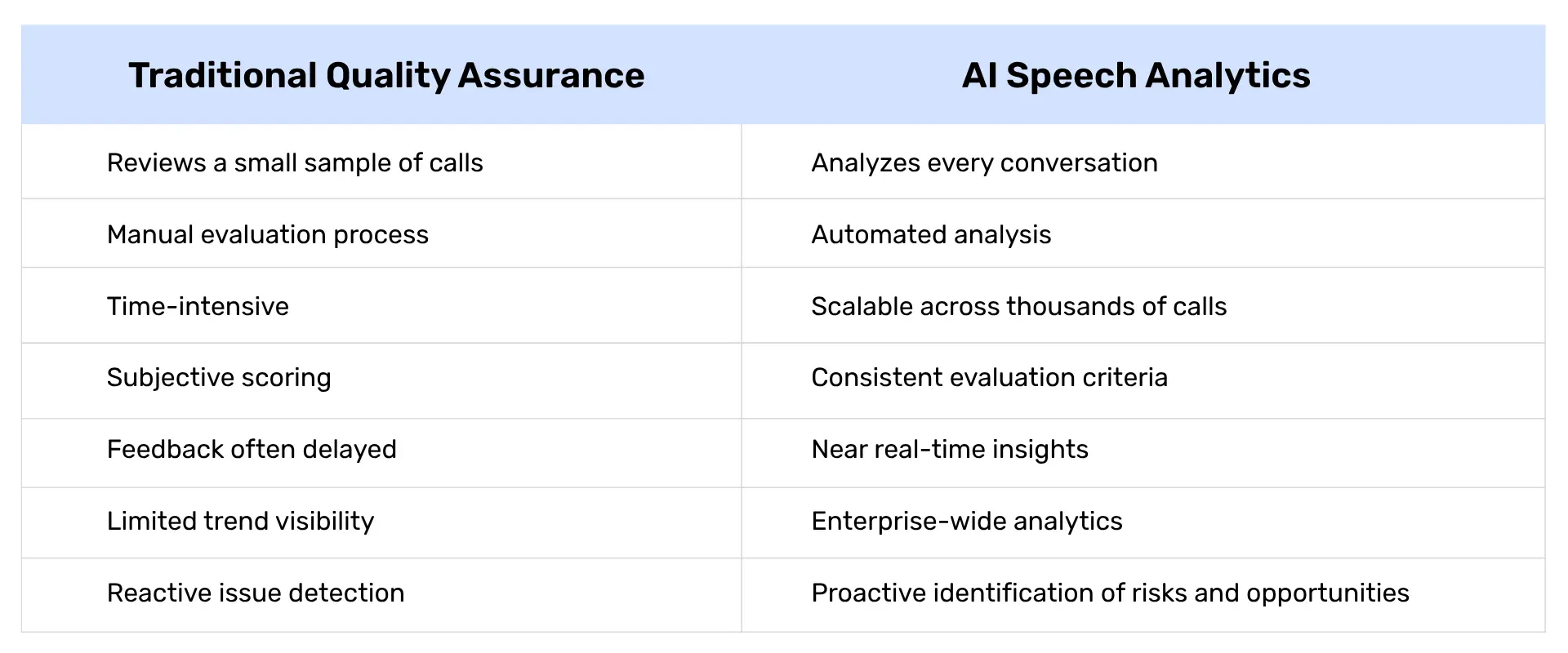
Traditional QA vs. AI Speech Analytics: Smarter insights, faster decisions.
This doesn't mean AI replaces quality assurance professionals.
Instead, it changes their role.
Rather than spending hours listening to recordings, supervisors spend more time coaching agents, improving customer journeys, and solving business problems.
Key Takeaway
AI Speech Analytics doesn't eliminate human expertise—it amplifies it. Automation handles repetitive analysis, while managers focus on coaching, decision-making, and continuous improvement.
Challenges of Implementing AI Speech Analytics
Like any enterprise technology initiative, AI Speech Analytics requires careful planning. Success depends not only on selecting the right platform but also on addressing data quality, integration, governance, employee adoption, and ongoing optimization.
Although the benefits are significant, implementing speech analytics isn't simply a matter of installing new software.
Organizations should understand the practical challenges involved to ensure successful adoption.
Audio Quality
Speech analytics performs best when conversations are clear.
Poor network connections, background noise, overlapping speakers, or low-quality recordings can reduce transcription accuracy.
Investing in high-quality communication infrastructure improves overall performance.
Multiple Languages and Regional Accents
Organizations operating across multiple regions often serve customers speaking different languages, dialects, and accents.
Modern AI models continue to improve multilingual support, but businesses should evaluate language capabilities based on their customer base.
Data Privacy and Security
Customer conversations frequently contain sensitive personal or financial information.
Organizations must ensure speech analytics platforms comply with relevant privacy regulations and internal security policies.
Important considerations include:
- Data encryption
- Access controls
- Audit logging
- Data retention policies
- Regional compliance requirements
Integration with Existing Systems
Speech analytics becomes significantly more valuable when connected with CRM platforms, helpdesk systems, knowledge bases, and business intelligence tools.
However, integrating multiple enterprise systems requires planning, governance, and technical expertise.
Employee Adoption
Introducing AI into customer support processes may raise concerns among employees.
Some agents may worry that technology is replacing their roles rather than supporting them.
Organizations should clearly communicate that speech analytics is designed to improve coaching, reduce repetitive tasks, and help employees succeed.
Training managers and agents early encourages stronger adoption.
Continuous Model Improvement
Customer behavior, products, and business priorities change over time.
Speech analytics models should be reviewed regularly to ensure they continue identifying relevant topics, intents, and business events accurately.
Successful implementations treat AI as an evolving capability rather than a one-time deployment.
Key Takeaway
Technology alone doesn't guarantee success. Organizations that combine strong governance, employee engagement, and continuous optimization achieve the greatest long-term value from AI Speech Analytics.
Best Practices for Successful Implementation
The most successful AI Speech Analytics initiatives begin with clear business objectives rather than technology alone. Organizations that align implementation with measurable outcomes are more likely to achieve sustainable improvements in customer experience and operational performance.
Every organization has different priorities.
Some focus on improving customer satisfaction.
Others prioritize compliance, operational efficiency, or sales performance.
Defining success early helps ensure the platform delivers meaningful business value.
Here are some best practices to guide implementation.
Start with Clearly Defined Goals
Before selecting a platform, identify the business problems you want to solve.
Examples include:
- Improving customer satisfaction
- Reducing average handling time
- Increasing First Call Resolution
- Strengthening compliance
- Improving agent coaching
Clear objectives make it easier to measure return on investment.
Begin with a Pilot Project
Rather than deploying across the entire organization immediately, start with a smaller business unit or customer support team.
A pilot project allows organizations to:
- Validate accuracy
- Measure business outcomes
- Refine workflows
- Build internal confidence
Lessons learned during the pilot simplify broader implementation.
Integrate Across the Business
The greatest value comes when speech analytics supports multiple departments.
Customer conversations can benefit:
- Customer Support
- Sales
- Marketing
- Product Development
- Compliance
- Operations
- Executive Leadership
Breaking down departmental silos enables organizations to gain a more complete understanding of customer needs.
Keep Humans in the Loop
AI provides recommendations, but people provide judgment.
Managers should continue reviewing conversations, coaching employees, and validating important business decisions.
Human oversight improves trust while ensuring responsible AI adoption.
Continuously Review Performance
Implementation isn't the finish line.
Organizations should regularly evaluate:
- Model accuracy
- Customer sentiment trends
- Operational KPIs
- Compliance performance
- User adoption
- Business outcomes
Continuous improvement helps organizations maximize long-term value.
Build a Data-Driven Culture
Perhaps the biggest shift isn't technological-it's cultural.
Organizations that consistently learn from customer conversations make faster decisions, identify opportunities earlier, and adapt more effectively to changing customer expectations.
Speech analytics becomes most valuable when conversation data influences decisions across the entire business rather than remaining confined to the contact center.
Final Takeaway
Successful AI Speech Analytics implementations combine the right technology with clear business goals, strong leadership, employee engagement, and continuous improvement. Organizations that embrace this approach gain far more than operational efficiencies—they build a deeper understanding of their customers and create a foundation for long-term competitive advantage.
The Future of AI Speech Analytics
AI Speech Analytics is rapidly evolving from a reporting tool into an intelligent business assistant. Instead of simply analyzing past conversations, the next generation of platforms will provide real-time guidance, predict customer behavior, automate decision-making, and deliver highly personalized customer experiences. Organizations that invest today will be better prepared for the future of customer engagement.
Not long ago, speech analytics was primarily used to review recorded conversations after customer interactions had ended.
Today, it can analyze every conversation automatically.
Tomorrow, it will become an active participant in customer interactions.
The role of speech analytics is expanding from helping organizations understand what happened to helping them decide what should happen next.
Let's explore some of the trends shaping the future of AI-powered contact centers.
Real-Time Agent Assistance
Imagine a newly hired customer support representative handling a complex customer enquiry.
Instead of placing the customer on hold to search documentation, the AI platform instantly suggests:
- Relevant knowledge base articles
- Recommended responses
- Troubleshooting steps
- Compliance reminders
- Product recommendations
- Next-best actions
The agent remains in control, but receives intelligent guidance throughout the conversation.
This shortens training time, improves consistency, and helps organizations deliver better customer experiences regardless of an agent's level of experience.
Generative AI for Contact Centers
Generative AI is already transforming the work that happens after a customer call ends.
Instead of manually documenting every interaction, organizations can automatically generate:
- Call summaries
- CRM updates
- Follow-up emails
- Support tickets
- Action plans
- Escalation reports
By reducing repetitive administrative work, agents can focus more on customers and less on documentation.
Predictive Customer Intelligence
Future speech analytics platforms won't simply explain what happened.
They'll help organizations anticipate what is likely to happen next.
By analyzing historical conversations alongside operational data, AI can identify customers who may be likely to:
- Cancel a subscription
- Escalate a complaint
- Purchase an upgraded service
- Require proactive support
- Leave negative feedback
Rather than reacting after problems occur, businesses can intervene earlier and improve customer outcomes.
Emotion-Aware Customer Experiences
Today's platforms primarily estimate customer sentiment.
Future solutions will develop a deeper understanding of customer emotions by combining:
- Conversation context
- Speaking patterns
- Voice characteristics
- Historical interactions
- Customer profiles
- Previous service experiences
This richer understanding will help organizations deliver more personalized, empathetic, and effective customer support.
Multilingual Intelligence
As organizations expand globally, supporting multiple languages becomes increasingly important.
Modern speech analytics platforms are already capable of recognizing many languages and regional accents.
Future systems will provide even stronger multilingual capabilities, including:
- Automatic language detection
- Real-time translation
- Cross-language analytics
- Consistent reporting across global operations
This enables multinational organizations to deliver consistent customer experiences regardless of geography.
Voice Biometrics
Customer authentication is another area undergoing significant change.
Instead of relying entirely on passwords or security questions, organizations are beginning to use voice characteristics as an additional layer of identity verification.
Voice biometrics can help:
- Reduce fraud
- Speed up authentication
- Improve customer convenience
- Lower Average Handle Time
Although adoption varies across industries, voice biometrics is expected to become increasingly common in sectors such as banking, insurance, and telecommunications.
Hyper-Personalized Customer Experiences
The future of customer service isn't simply faster support.
It's more relevant support.
By combining speech analytics with CRM data, purchase history, customer preferences, and previous interactions, organizations can tailor conversations to each individual customer.
For example, an agent may automatically receive recommendations based on:
- Previous purchases
- Open support cases
- Preferred communication channels
- Loyalty status
- Product ownership
- Past customer satisfaction
This enables organizations to deliver more personalized experiences while strengthening long-term customer relationships.
Key Takeaway
The future of AI Speech Analytics extends well beyond call analysis. It is becoming an intelligent decision-support system that helps organizations anticipate customer needs, improve operational performance, and deliver exceptional customer experiences.
Integrating AI Speech Analytics with Enterprise Systems
Speech analytics becomes even more valuable when it is connected to the systems organizations already use every day. Integrating conversation insights with CRM, ERP, helpdesk, workforce management, and business intelligence platforms creates a unified view of customer interactions across the enterprise.
Customer conversations shouldn't exist in isolation.
The information collected during support calls often benefits multiple departments beyond the contact center.
When AI Speech Analytics integrates with existing business applications, customer insights become part of the organization's broader digital ecosystem.
Customer Relationship Management (CRM)
Integrating speech analytics with CRM systems allows organizations to automatically:
- Update customer records
- Store call summaries
- Track customer sentiment
- Record action items
- Improve sales forecasting
Sales and support teams gain a more complete understanding of every customer relationship.
Helpdesk and Ticketing Systems
Rather than manually creating support cases, AI can automatically:
- Generate tickets
- Assign priorities
- Route requests
- Suggest resolutions
- Update ticket status
This reduces manual effort while improving response times.
Knowledge Management Systems
Customer conversations often reveal new questions before documentation is updated.
Speech analytics helps organizations continuously improve:
- FAQs
- Knowledge bases
- Self-service portals
- Internal training materials
As customer needs evolve, knowledge resources evolve alongside them.
Workforce Management
Understanding conversation trends helps managers plan staffing more effectively.
Speech analytics can identify:
- Peak support periods
- Common enquiry types
- Seasonal demand
- Coaching requirements
- Team performance trends
This supports better workforce planning and resource allocation.
Business Intelligence Platforms
Conversation data becomes even more valuable when combined with operational metrics, customer surveys, and business performance data.
Executives gain a unified view of customer experience across the organization, helping them make faster, more informed strategic decisions.
Key Takeaway
The greatest value of AI Speech Analytics comes when conversation insights flow seamlessly across the business, supporting customer service, sales, compliance, operations, and executive decision-making.
How Kaira Software Can Help
Every organization has unique customers, business processes, compliance requirements, and technology environments.
Successfully implementing AI Speech Analytics requires more than purchasing software. It requires the right strategy, seamless integration, and ongoing optimization.
At Kaira Software, we help organizations design and implement intelligent customer engagement solutions tailored to their business goals.
Our expertise includes:
AI-Powered Contact Center Solutions
Develop intelligent platforms that analyze customer conversations, automate repetitive tasks, and improve service quality through AI-driven insights.
Enterprise AI Integration
Connect speech analytics with CRM platforms, ERP systems, helpdesk applications, knowledge bases, and business workflows to create a unified customer experience.
Custom AI Development
Build AI solutions tailored to your industry, operational processes, compliance requirements, and customer engagement strategies.
Intelligent Chatbots and Virtual Assistants
Enhance customer support with AI-powered chatbots and virtual assistants that integrate seamlessly with contact center operations.
Business Process Automation
Reduce manual effort by automating repetitive activities such as CRM updates, ticket creation, reporting, workflow approvals, and post-call documentation.
AI Analytics Dashboards
Provide decision-makers with real-time visibility into customer sentiment, operational performance, compliance, and business trends through intuitive dashboards.
Whether you're modernizing an existing contact center or building an AI-first customer engagement strategy, Kaira Software can help transform customer conversations into measurable business value.
Frequently Asked Questions(FAQs)
Conclusion
Every customer conversation tells a story.
Some reveal service issues that need immediate attention. Others highlight product feedback, sales opportunities, compliance risks, or emerging customer expectations. Collectively, these conversations represent one of the richest sources of business intelligence available to any organization.
The challenge has never been collecting customer conversations—it has been understanding them at scale.
AI Speech Analytics changes that.
By combining speech recognition, natural language processing, machine learning, and generative AI, organizations can move beyond manual call reviews and begin learning from every customer interaction. The result is better customer experiences, more productive support teams, stronger compliance, and faster, data-driven decision-making.
As customer expectations continue to evolve, organizations that invest in conversational intelligence will be better positioned to deliver personalized service, improve operational efficiency, and build stronger customer relationships.
Whether you're taking your first steps toward AI adoption or expanding an existing digital transformation strategy, AI Speech Analytics provides a practical way to unlock the value hidden within everyday customer conversations.
If you're exploring AI-powered contact center solutions, Kaira Software can help you design, integrate, and optimize AI Speech Analytics tailored to your business needs.
Ready to transform customer conversations into business intelligence?
Contact Kaira Software to discover how AI Speech Analytics can help improve customer experience, strengthen compliance, and turn every conversation into an opportunity for growth.