

Diffusion Gemma: How Google's New AI Model Could Transform Local AI
Artificial Intelligence is evolving rapidly, and one of the most interesting developments of 2025 is Google's introduction of Diffusion Gemma, an experimental text generation model built on diffusion architecture rather than the traditional autoregressive approach used by most Large Language Models (LLMs).
For years, AI text generation has been dominated by models that generate content one token at a time. While this approach has powered impressive tools such as ChatGPT, Gemini, Claude, and Llama, researchers have continued exploring alternative architectures that could offer improvements in speed, efficiency, and quality.
Google's Diffusion Gemma represents a significant step in bringing diffusion-based text generation into the mainstream.
What is Diffusion Gemma?
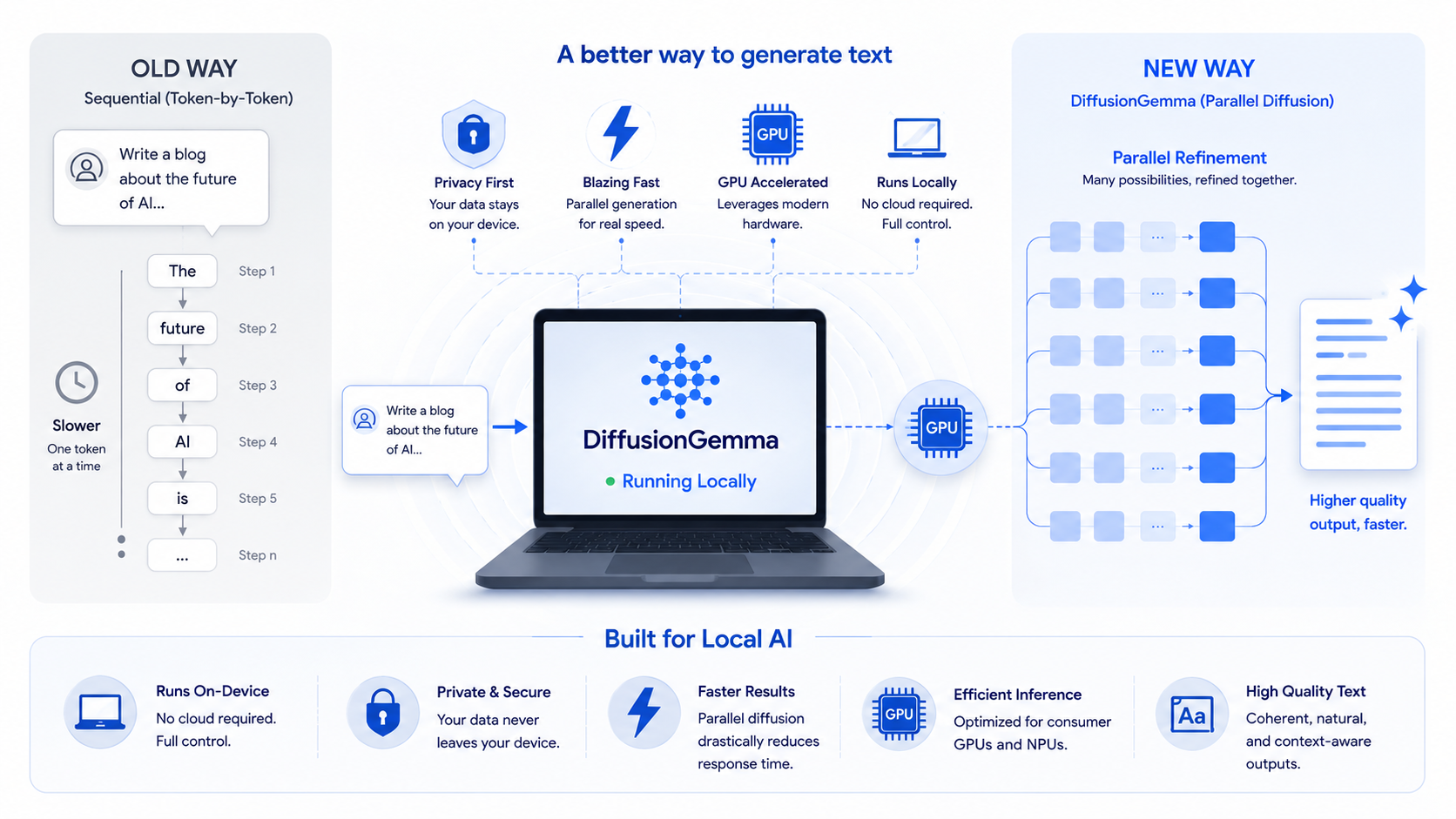
Diffusion Gemma uses parallel diffusion-based text generation instead of traditional token-by-token generation, enabling faster, more private, and locally deployable AI applications.
Diffusion Gemma is a new experimental language model released by Google that applies diffusion techniques to text generation.
Most language models generate words sequentially. They predict the next token based on previous tokens and continue this process until a complete response is produced.
Diffusion models work differently.
Instead of generating text from beginning to end, they start with a noisy representation and progressively refine it through multiple steps until a coherent output emerges.
This technique has already revolutionized image generation through models such as Stable Diffusion and Imagen. Google's latest research explores whether similar benefits can be achieved for text generation.
The result is Diffusion Gemma, a lightweight, research-focused model designed to demonstrate the potential of diffusion-based language generation.
Why This Matters
The launch of Diffusion Gemma is important because it validates a growing belief within the AI community that text generation may not always need to rely on traditional autoregressive architectures.
Earlier this year, we explored this concept in our article on MercuryAI and diffusion-based text generation.
As discussed in our blog, MercuryAI vs. ChatGPT: What Inception Labs' New Model Means for the Future of AI, diffusion models offer an alternative path toward faster and potentially more efficient language generation.
Google's entry into this space adds significant credibility to the diffusion-text movement and suggests that major technology companies see long-term potential in this architecture.
Key Advantages of Diffusion Gemma
1. Faster Text GenerationTraditional LLMs generate text token by token.
This process can become slower as outputs grow longer because every new token depends on previously generated content.
Diffusion-based models generate and refine larger portions of text simultaneously.
This parallel generation approach has the potential to significantly reduce latency and improve overall response times.
For real-time AI applications such as customer support, intelligent assistants, and workflow automation, faster generation can directly improve user experience.
One of the most exciting aspects of Diffusion Gemma is its focus on efficiency.
Smaller, optimized models can make local AI deployment more practical for businesses and developers.
Running AI locally offers several benefits:
- Reduced cloud dependency
- Lower inference costs
- Faster response times
- Greater control over data
- Improved operational resilience
As organizations increasingly explore on-device AI, lightweight diffusion models may become an attractive option for edge computing and enterprise environments.
3. Improved PrivacyPrivacy concerns continue to shape enterprise AI adoption.
Many organizations remain cautious about sending sensitive information to cloud-hosted AI systems.
Local deployment enabled by efficient models such as Diffusion Gemma can help address these concerns.
When AI processing occurs on local infrastructure or user devices, organizations gain greater control over:
- Customer information
- Internal documents
- Proprietary business data
- Regulatory compliance requirements
For industries such as finance, healthcare, insurance, and telecommunications, privacy-focused AI solutions are becoming increasingly valuable.
4. High Quality Output Through Iterative Refinement
Diffusion models generate content through repeated refinement cycles.
Instead of committing to each word immediately, the model continuously improves the generated text until a final output is produced.
This iterative process may offer advantages in:
- Coherence
- Consistency
- Error correction
- Context preservation
While research is still ongoing, many experts believe this refinement-based approach could unlock new possibilities for text quality and controllability.
What Does This Mean for Businesses?
The emergence of Diffusion Gemma signals that the AI landscape is expanding beyond traditional LLM architectures.
Businesses should pay attention because future AI systems may offer:
- Faster response generation
- Lower infrastructure costs
- More privacy-preserving deployments
- Improved edge-device performance
- Greater flexibility for enterprise applications
Organizations evaluating AI strategies should recognize that the future may not belong exclusively to autoregressive models. Hybrid architectures and diffusion-based approaches could become important components of next-generation AI solutions.
Challenges Still Remain
Despite its promise, diffusion-based text generation is still in an early stage.
Researchers continue working on challenges such as:
- Optimizing inference efficiency
- Scaling model capabilities
- Benchmarking against leading LLMs
- Improving long-context performance
- Expanding enterprise use cases
Diffusion Gemma should therefore be viewed as an important research milestone rather than a complete replacement for current LLMs.
However, the direction is clear: diffusion models are rapidly moving from experimental concepts to practical AI technologies.
The Future of Diffusion-Based AI
The AI industry is entering a period of architectural experimentation.
Just as transformer models reshaped AI over the past decade, diffusion architectures may influence the next generation of language models.
The appearance of both MercuryAI and Diffusion Gemma within a short timeframe suggests growing momentum behind diffusion-based text generation.
As these models become more efficient and capable, they could play a major role in enabling faster, more private, and more accessible AI experiences.
For developers, businesses, and AI enthusiasts, Diffusion Gemma is more than a research release. It is a glimpse into what the next chapter of artificial intelligence may look like.
Final Thoughts
Google's Diffusion Gemma marks an important milestone in the evolution of AI text generation. By bringing diffusion architectures into the Gemma ecosystem, Google is helping move diffusion-based language models closer to mainstream adoption.
The combination of speed, privacy, efficiency, and local deployment potential makes this development particularly relevant for enterprises exploring the future of AI.
While traditional LLMs remain dominant today, innovations such as Diffusion Gemma suggest that the future of AI may be shaped by a wider range of architectures than ever before.
As the industry continues to evolve, businesses that stay informed about emerging AI technologies will be best positioned to capitalize on the next wave of innovation.
Frequently Asked Questions(FAQs)
Ready to Explore Local AI for Your Business?
As models like Diffusion Gemma push AI closer to the device, businesses have new opportunities to improve privacy, reduce cloud costs, and deliver faster AI experiences. Whether you're evaluating AI chatbots, knowledge assistants, sales enablement tools, or custom AI applications, choosing the right architecture is becoming just as important as choosing the right model.
At Kaira Software, we help organizations evaluate, implement, and integrate emerging AI technologies into real-world business workflows. From Generative AI solutions to custom AI-powered applications, we can help you build systems that are secure, scalable, and future-ready.
Interested in exploring AI solutions for your organization? Contact us today and let's discuss what's possible.