

OpenAI ChatGPT Personal Finance Update and Codex From Anywhere
OpenAI has launched two major updates that show where ChatGPT is headed next. The first is a new ChatGPT personal finance experience, and the second is the ability to work with Codex from anywhere through the ChatGPT mobile app.
Together, these updates make ChatGPT more useful for real-world tasks. One helps users manage money with more context. The other helps developers continue coding work from mobile devices, remote environments, and connected machines.
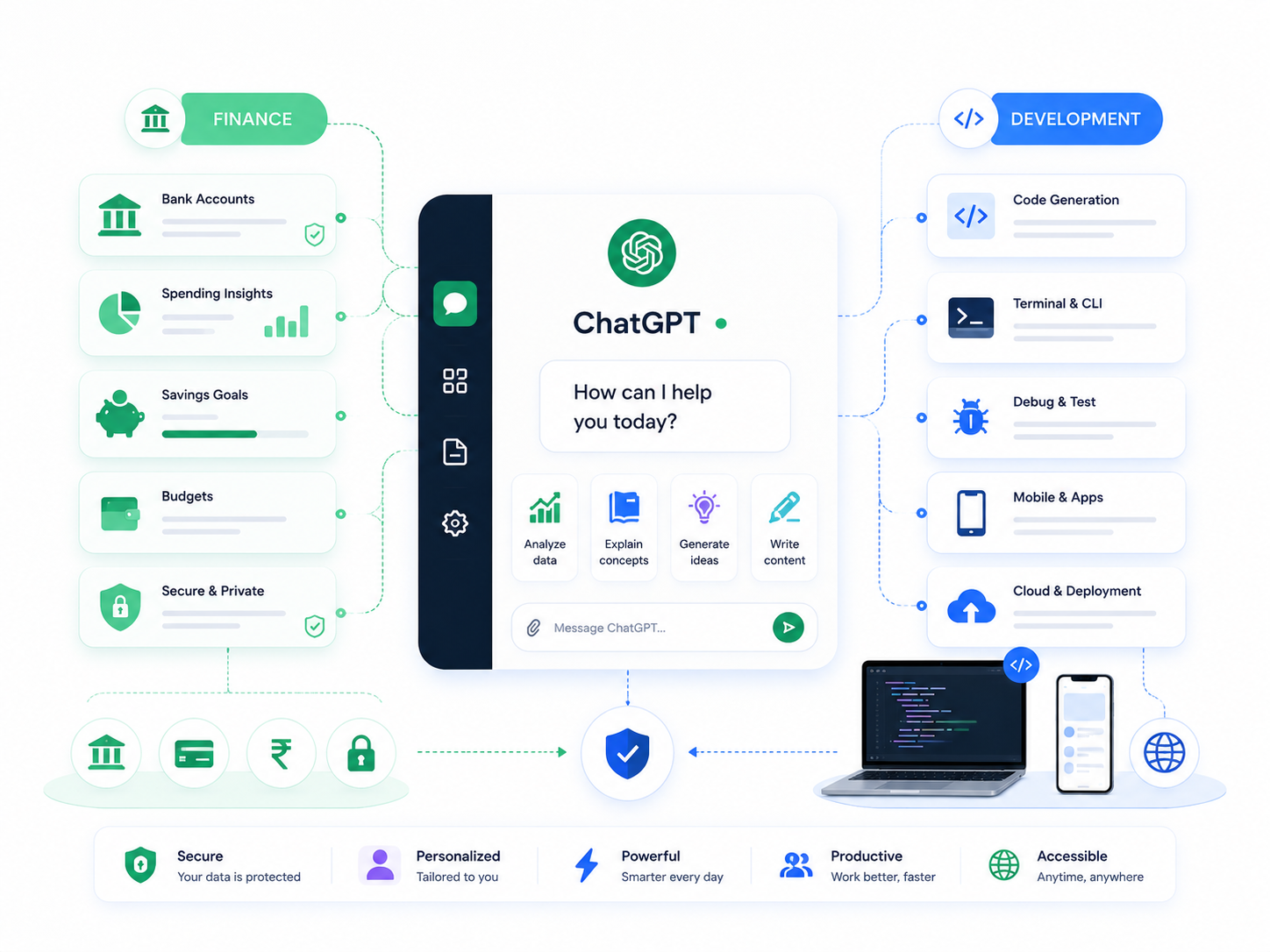
Finance + Coding: The New AI Workflow Ecosystem
What Is the New ChatGPT Personal Finance Update?
The new ChatGPT personal finance update gives Pro users in the U.S. a preview experience that lets them connect financial accounts and ask questions based on their actual money data.
Instead of giving only general budgeting advice, ChatGPT can now help users understand spending, subscriptions, upcoming payments, and investment context in one place. This makes ChatGPT more relevant for people who want a smarter personal finance assistant.
OpenAI says the experience is available on web and iOS and supports more than 12,000 financial institutions through Plaid, with Intuit support coming soon. That means users can start bringing together information from different accounts and use ChatGPT as a central financial helper.
Why the ChatGPT Finance Feature Matters
The ChatGPT personal finance feature matters because money questions are highly personal and context-driven. Generic advice is often not enough when someone is trying to manage a budget, track spending, or plan for a major goal.
With this update, ChatGPT can respond using the user’s real financial context, which makes the answers more specific and practical. That is a big step forward for anyone looking for AI financial planning help, personal budgeting support, or a conversational way to review spending patterns.
OpenAI also says users remain in control of their data. They can disconnect accounts, delete memories, and use temporary chats that do not access connected financial data. For a sensitive topic like personal finance, privacy and user control are essential.
How the Personal Finance Experience Works
The new finance experience starts in a Finances section inside ChatGPT, where users can connect their accounts and let ChatGPT sync and organize their data.
Once connected, ChatGPT can show a dashboard with spending, subscriptions, upcoming payments, and other financial activity. Users can also add broader context, such as a mortgage, savings goal, or future purchase plan, so the assistant can give more useful guidance.
OpenAI says connected finance conversations default to GPT-5.5 Thinking, which is designed for more complex reasoning. That makes sense because financial planning often requires comparison, tradeoffs, and long-term thinking rather than simple answers.
What Does “Work with Codex from Anywhere” Mean?
OpenAI’s second update is focused on developers. The new work with Codex from anywhere feature brings Codex into the ChatGPT mobile app, making it possible to manage coding tasks while away from the desk.
Codex is now available in preview on iOS and Android, and it works across laptops, devboxes, and remote environments. Users can review work, approve commands, change models, or start new tasks from their phone while Codex keeps running in the background.
This is a major improvement for software developers who want remote coding support and mobile developer workflows. It turns Codex into a more flexible assistant for real engineering work.
Why Codex Mobile Access Matters
The ability to work with Codex from anywhere matters because coding does not always happen in one place. Developers move between meetings, commutes, support calls, and planning sessions, and they often need to stay connected to active tasks.
With the mobile app, users can check progress, review diffs, inspect terminal output, and approve actions without being tied to a desktop machine. That creates a smoother AI coding experience and helps teams move work forward faster.
OpenAI also says Codex supports Remote SSH, which allows it to connect into managed remote environments and continue work securely. This makes the feature especially useful for teams that already rely on cloud-based development systems.
ChatGPT Is Becoming More Useful for Real Work
These two updates are different in purpose, but they share the same direction. OpenAI is making ChatGPT a more practical tool for everyday work by connecting it to real context and real workflows.
The ChatGPT finance update helps users manage money with more personalized insights. The Codex update helps developers continue coding from anywhere with mobile access and remote connections. In both cases, the goal is the same: reduce friction and make AI more useful in real life.
This is an important step in the evolution of AI assistants. ChatGPT is no longer just a place to ask questions. It is becoming a system that can support decisions, guide actions, and keep users connected to important tasks.
Privacy, Trust, and Control
As AI tools move closer to sensitive information, trust becomes more important. That is especially true for AI in personal finance, where users need confidence that their financial data is secure.
OpenAI says users can disconnect accounts, delete memories, and manage their data carefully. For Codex, the remote setup is designed to keep trusted machines reachable without opening them directly to the public internet.
These protections matter because the more useful an AI assistant becomes, the more responsibility it has to handle data safely. OpenAI appears to be building these updates with that reality in mind.
Final Thoughts
The latest ChatGPT updates show that OpenAI is pushing the product toward deeper utility. The new ChatGPT personal finance experience makes the assistant more helpful for budgeting, spending analysis, and financial planning.
At the same time, working with Codex from anywhere gives developers a better way to manage coding tasks on the move. Both updates point to the same bigger trend: ChatGPT is becoming a more context-aware and action-oriented AI platform.
For users, that means less switching between apps and more time getting real work done. For OpenAI, it marks another step toward making ChatGPT a central tool for both personal and professional workflows.
Stay tuned for more such updates as AI continues to evolve from a simple assistant into a more practical tool for everyday work and decision-making.
Frequently Asked Questions(FAQs)