

From Apps to AI OS: The Shift Toward Agent-Driven Computing
From Chat Interfaces to Digital Workflows
What began as a conversational interface for asking questions and generating text has steadily expanded into something much broader. AI systems that started as chat tools are now embedded across most digital workflows. Writing documents, building software, preparing spreadsheets, generating images, editing video, or working with audio no longer require the same level of specialized expertise they once did. AI acts as an assistive layer, lowering the learning curve and helping users complete tasks more efficiently.
The chat interface itself has evolved significantly. Early systems were largely closed, relying only on their pre-trained knowledge. The introduction of extensibility mechanisms such as MCP servers changed this model. These allowed AI systems to connect to external tools, data sources, and services dynamically. Instead of being limited to static knowledge, the AI could fetch information, perform actions, and adapt to new capabilities as needed.
Over time, this shifted the role of chat from a support tool to a coordination layer. Features such as browser usage and direct computer interaction introduced basic automation. Users could ask the AI not only for guidance, but also to carry out steps on their behalf. The chat interface began to resemble a lightweight platform rather than a single-purpose application.
When Chat Started Behaving Like a Platform
As these capabilities expanded, ecosystems of plugins and extensions emerged. Functionality could be added without installing traditional software in the usual sense. This mirrored app marketplaces in spirit, though the interaction model remained conversational.
At the same time, the boundary between “using an app” and “asking the system to do something” became less clear. The interface stayed the same, but the scope of what could be accomplished through it increased steadily.
AI Moves into the Operating System
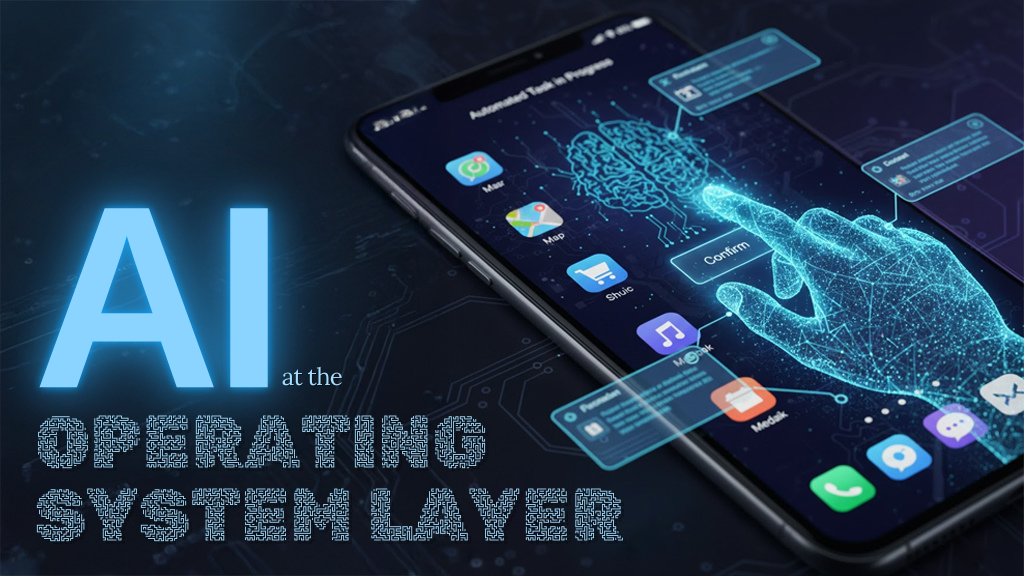
AI moving from applications into the operating system layer, enabling intent-driven actions across apps and services.
A more recent development pushes this idea further by integrating AI directly at the operating system level. In the case of ZTE’s Nubia M153, AI is not just another app running on top of the system. It is embedded into the OS itself. This allows the AI to access device-level functions and coordinate actions across applications.
From the user’s perspective, tasks can be initiated using natural language, while the system determines which apps to open, what steps to take, and how to complete the request. Importantly, this does not require users to learn new interaction patterns or workflows.
What also makes this approach notable is that existing applications continue to work as they always have. Developers are not forced into immediate rewrites. The AI layer sits above the app ecosystem, translating intent into system actions.
Privacy, Control, and System-Level Risk
As AI moves closer to the operating system, questions of privacy and control become more important. An AI that can access apps, files, system settings, and user behavior inherently operates with a broader permission set than traditional applications. While this enables smoother automation, it also expands the potential impact of misuse, misconfiguration, or unintended behavior.
System-level access changes the security model. A flaw at the OS or agent layer can affect multiple applications at once, rather than being contained within a single app. This makes transparency, permission boundaries, and auditability critical. Users and organizations need clear visibility into what actions an AI agent is allowed to perform and under what conditions.
There are also implications for data handling. When intent is interpreted centrally, sensitive information may flow through the OS-level AI even if it originates in different applications. This raises questions about data isolation, on-device processing, and how much context should be retained or discarded after tasks are completed.
From an enterprise perspective, governance becomes as important as capability. Policies around access control, logging, human-in-the-loop approvals, and fallback mechanisms will be necessary to ensure that automation does not come at the cost of trust or compliance. The shift toward AI-native operating systems makes security and privacy foundational design concerns rather than features added later.
Applications Without Fixed Interfaces
This model hints at a longer-term change in how applications are built. At their core, apps exist to expose data and functionality. If an AI system can interpret intent and generate an interface dynamically, the fixed UI becomes less critical.
In such a setup, developers may focus more on APIs and service layers. Interfaces become contextual outputs, generated when needed rather than permanently designed. The operating system and AI layer decide how information is presented based on the situation.
Toward Devices That Adapt to Context
Once interfaces are no longer tied to a single screen, interaction naturally expands to other devices. Information can be delivered through voice, audio, wearables, or lightweight visual displays. A message might be read aloud through earphones or shown briefly on smart glasses.
This does not imply the disappearance of screens. Instead, it suggests a more selective use of them. The AI system chooses the most appropriate medium for the task at hand.
What This Shift Signals
This evolution does not point to the immediate end of apps, but to a gradual evolution. Applications become service-first, interfaces become flexible, and the operating system takes on a more active coordinating role.
What we are seeing today are early indicators rather than a finished model. Still, they offer a clear direction of travel. AI is moving closer to the operating system, and with it, the way we interact with software continues to change.
What this means for builders and decision-makers
If you are designing digital products, operating platforms, or planning long-term technology roadmaps, this shift is worth paying attention to. The move toward AI-native operating systems, service-first applications, and dynamically generated interfaces will affect how software is built, integrated, and delivered.
Now is a good time to evaluate:
Whether your applications are API-first and automation-ready
How easily your systems can expose functionality to AI agents
What role your current UI will play in an OS-level, agent-driven future
If you would like to discuss how your product or platform can prepare for this transition, or explore practical steps toward agent-ready architecture, feel free to reach out or start a conversation with our team.
As AI moves from apps to the operating system, business architecture must evolve.
Consult with Kaira Software to assess readiness for agent-driven systems and practical AI integration.
Connect with us to start the conversation.
Frequently Asked Questions (FAQs)
Designing API-first systems
Cleaning and structuring operational data
Identifying workflows suitable for agent-based automation
Evaluating how AI can operate across tools, not just within them