

Agent2Agent (A2A) Protocol: A Deep Dive into Decentralized Agent Communication
Modern distributed systems increasingly rely on autonomous software agents to perform complex tasks with minimal human intervention. Efficient communication between these agents is crucial for coordination, collaboration, and overall system intelligence. The Agent2Agent (A2A) Protocol establishes a standardized framework that enables direct, secure, and real-time interaction among agents, regardless of the underlying infrastructure.
The design of A2A extends beyond cloud environments. It suits a broad range of deployment scenarios, including on-premises, edge computing, and hybrid systems. This versatility makes A2A a fundamental technology for enabling intelligent, decentralized ecosystems across industries.
What Is the Agent2Agent (A2A) Protocol?
The Agent-to-Agent (A2A) protocol is a structured communication framework that enables direct, real-time interaction between software agents operating in decentralized environments. These agents—whether they are microservices, monitoring bots, orchestration tools, or intelligent automation modules—often need to share information, coordinate tasks, and make collaborative decisions. The A2A protocol provides a standardized mechanism for such inter-agent communication, eliminating the inefficiencies and vulnerabilities associated with ad-hoc integration methods. While A2A is commonly employed in cloud-based systems, it is equally applicable in on-premises, edge, and hybrid infrastructures, making it a versatile solution for a wide range of deployment scenarios.
A2A enables distributed agents to negotiate, delegate tasks, and coordinate interactions securely and interoperably. State synchronization, if needed, typically requires additional coordination mechanisms or shared infrastructure.
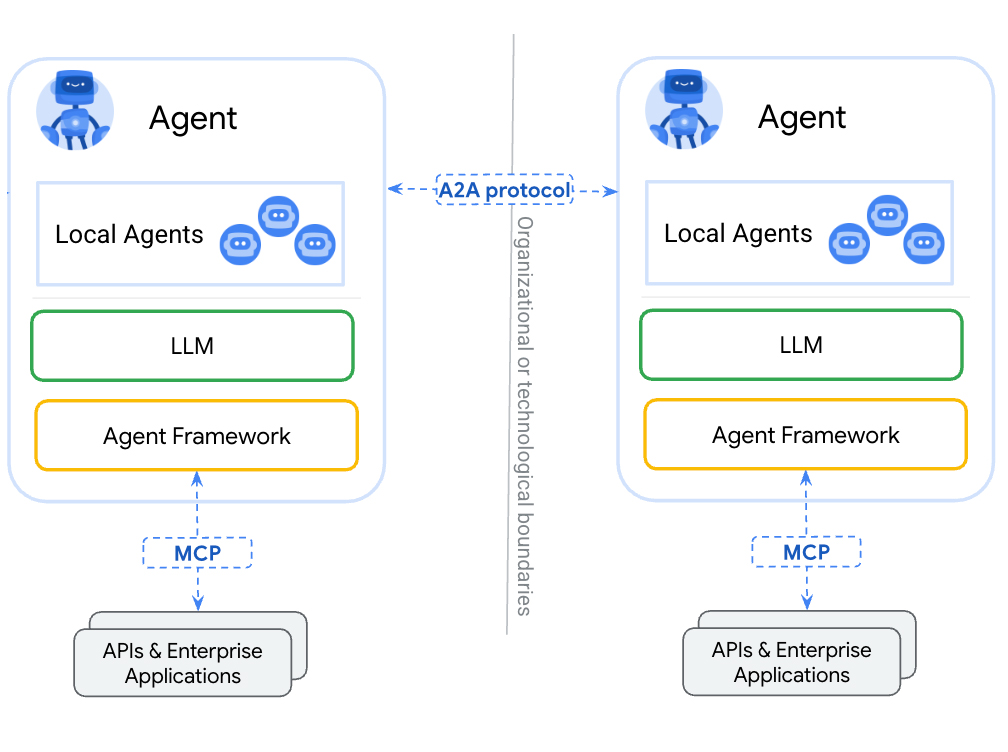
Key Benefits of Implementing the A2A Protocol in Distributed Environments
Implementing the Agent-to-Agent (A2A) protocol offers a wide array of strategic and operational advantages for organizations operating in distributed systems—whether in the cloud, on-premises, at the edge, or across hybrid infrastructures. A2A enables seamless communication between autonomous agents, enhancing interoperability, scalability, and security across diverse deployment scenarios.
Improved Interoperability: A2A acts as a unifying language for diverse agents, enabling seamless integration regardless of programming languages, platforms, or service architectures.
Enhanced Scalability: With A2A, new agents can be added or removed from the ecosystem without disrupting existing workflows, supporting dynamic scaling.
Reduced Latency and Overhead: By facilitating direct communication between agents, A2A minimizes the need for intermediary services or polling mechanisms, optimizing resource utilization.
Greater Resilience: A2A supports decentralized decision-making and fault-tolerant communication patterns, improving system robustness.
Security and Compliance: Built-in encryption, authentication, and authorization mechanisms help ensure that agent interactions adhere to enterprise-grade security standards.
Usage Scenarios of the A2A Protocol: Real-World Applications
The versatility of the A2A protocol allows it to be adopted across a multitude of industries. Below are some illustrative scenarios that highlight its value:
1. DevOps & IT AutomationIn continuous integration and delivery (CI/CD) pipelines, A2A can enable automated build agents, testing agents, and deployment tools to coordinate intelligently. For instance, upon detecting a successful build, the test agent can notify the deployment agent in real time, reducing delays and manual intervention.
2. Finance & BankingRisk management agents in a financial cloud infrastructure can use A2A to exchange transaction metadata, fraud detection alerts, and compliance verifications. This leads to faster fraud detection and real-time compliance reporting without overburdening core systems.
3. Healthcare Cloud PlatformsElectronic Health Record (EHR) agents, diagnostic bots, and telemedicine modules can utilize A2A to share patient data securely and in accordance with HIPAA regulations. For example, a diagnosis agent can request real-time lab data from another agent and immediately recommend treatment adjustments.
4. E-Commerce and LogisticsInventory tracking agents, recommendation engines, and order fulfillment systems can communicate using A2A to deliver a seamless user experience. For example, a drop in stock levels can trigger an alert to procurement agents, while simultaneously updating delivery timelines via logistics agents.
Leveraging A2A for Enhanced Cloud Infrastructure and Operations
Adopting the A2A protocol enables businesses to move towards fully autonomous cloud operations (AIOps). Here’s how organizations can harness its capabilities:
Microservice Mesh Optimization: A2A can enhance service discovery, routing, and load balancing among microservices without the complexity of centralized control systems.
Proactive Monitoring and Incident Response: Monitoring agents can collaborate via A2A to detect anomalies, escalate issues, and auto-remediate failures before end-users are impacted.
Cross-Cloud Orchestration: A2A empowers agents in multi-cloud or hybrid environments to coordinate resource provisioning, migration, and failover processes efficiently.
Policy-Based Governance: Agents managing compliance, cost optimization, and performance tuning can share insights and enforce policies dynamically across the cloud estate.
The Future of A2A: What’s on the Horizon?
With artificial intelligence and edge computing gaining momentum, the A2A protocol is poised to play an even more transformative role. Future developments are expected to include:
AI-Augmented Agents: With integration into machine learning models, agents will be capable of predictive decision-making, enabled through A2A exchanges.
Inter-Organizational Agent Collaboration: Secure federated protocols will allow agents from different enterprises to communicate for supply chain optimization, federated learning, and shared services.
Self-Healing Cloud Systems: A2A will be critical in enabling agents to collaboratively detect, diagnose, and self-correct infrastructure anomalies without human intervention.
Standardization and Open Protocol Development: Industry-wide adoption may lead to the establishment of global standards for agent communication, positioning A2A as a foundational element in the future of distributed and autonomous system architectures—regardless of whether they are cloud-based, on-premises, or hybrid.
Final Thoughts: Embrace the Power of the Agent-to-Agent Protocol
In a world increasingly driven by automation and intelligent systems, the Agent-to-Agent (A2A) Protocol emerges as a foundational pillar for enabling seamless, secure, and scalable interactions among distributed agents. By bridging communication gaps, enhancing coordination, and supporting autonomy across diverse environments—whether cloud-based, on-premises, or hybrid—A2A sets the stage for more intelligent, self-managing systems of the future.
At Kaira Software, we believe in enabling intelligent, connected systems that drive business transformation. If you're exploring ways to future-proof your cloud strategy and build a more autonomous, resilient infrastructure, it's time to consider integrating A2A.
🔗 Learn more about the protocol on the Google Developer Blog
Frequently Asked Questions (FAQs)
Stay tuned to the Kaira Software blog for more insights into emerging cloud technologies and best practices.